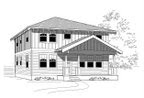

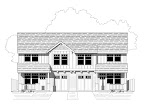
Normally we get to draw our plans on paper and then ship them off to a builder, never to be heard from again. But a recent purchase of the Arleta 2850 was being built a couple of hours away and we just happened to be driving through very recently. The house is very nearly done just needing final trim and landscaping. It looks nice. But not what we pictured...
The house was built in a fairly lax jurisdiction so the builder was able to change some windows and structural issues without much fuss. Unfortunately the effect of replacing sets of single hungs with gigantic sliding windows killed some of the period effects. As did the rounded sheetrock corners, lack of wood trim, casing, and floors. Now it's understood that most people these days prefer carpet in bedrooms but we find it unappealing. The front porch was unfinished but at this point we're not holding out for a miracle.
Lesson learned? Not quite sure yet. While our plans are purposefully Spartan on details, we do get disappointed when our vision isn't matched. Perhaps a set of SketchUp images showing our vision for the plan would be in order. In fact this plan has some rough sketches ready, they just need some refining and uploading. Perhaps that's the rub.
If ever you purchase an Istockhouseplans house plan and would like some direction towards creating a Craftsman or period look, please let us know and we'll be happy to put together a 3-d image for you. Just one more service that we offer.
Showing posts with label diatribe. Show all posts
Showing posts with label diatribe. Show all posts
Tuesday, August 20, 2013

Tuesday, December 14, 2010
Some comments on Real Estate Agents
First off, we want to say that we appreciate realtors very much for the upstream job they do in selling our plans. Granted, they don't sell our plans directly, but they do sell the building that the contractor created from our plans. But there are some things that we'll never understand. Most likely this can just be chalked up to personality types, life direction, etc. Sort of like we will never understand the Chinese culture. If you are a realtor, we invite you to respond with intelligent answers in an attempt for open communication.
1. Why does all of your marketing material have your face on it? Why do we care what you look like? Some of you are not very attractive, even with glamor shots and PhotoshopTM. Maybe you say it's because your face is your image and it's how people remember you. We think you guys all look the same. Same with insurance agents and lawyers. But the contractors who build our plans don't advertise with their face. As building designers, we don't advertise our face (we know better!). Plumbers don't, electricians don't, and the guy who lays the carpet doesn't. So why do you? Is this the way it's always been done? We'll bet if you used something other than your face, you might get noticed as being unique. Just a thought. Maybe an icon of a house with some zoom lines around it that says "I make quick sales". That's what we really want anyway, not your face on a lawn sign.
2. I understand that not anyone can get a realtors license. You've got to have patience, a study guide, and $500 to take the test. So why on the test do they not mention anything about house styles? I swear, every other house listed in our local paper is a 'bungalow'. I know for a fact that there are not that many bungalows in the state. Is a bungalow sexy or something? Or is it just a cop-out because other housing styles aren't known? We've seen tudor, craftsman, prairie, ranch and victorian all listed as bungalow. Another one that crops up is 'old Portland style'. What!? Which style? This one really is a cop-out. It's used a lot on prairie cubes and bungalows where the word bungalow has been already overused. If I may suggest, could you research housing styles and figure out more than five?
3. Why did we receive junk mail and solicitations AFTER we bought our current abode? Did you think that we would be so impressed by a circular with your face on it that we would immediately want to buy another home? Like we could afford that? Instead, the timing of your mailer was so backwards that we looked at it, made fun of the timing, and then recycled it without another thought. No, I don't know who it was, you all look the same. It would be understandable if Istockhouseplans chose to leave catalogs on construction sites. Builders tend to build more than 1 house every 3-5 years.
4. Maybe the general public can't tell, but some of your fliers for houses are less than spectacular. The fliers themselves sometimes use gaudy colors or err on the other side of no bling at all. AT ALL. We do want to see more than a list of 'amenities' in 10 pt font and 4 1"x1" photos of the house. But we don't want to see what looks like a beginner's guide to every option in Print ShopTM. A simple left margin graphic, 3 colors, and appropriate font size are a good place to start. And make the price tag big enough that it can be seen through the 'take one' flier box, in the rain, from the car, at the curb. We are not pleased with having to open the door in a downpour to grab a flier (or 110 degree temps for those in SoCal). The mere act of touching a flier will not increase the chances of buying a house. Folks who are driving through a neighborhood they haven't been through before do not want to write down an address to look up when they get home. They'll forget. Or they will merely go the next house with a post and shingle and look at the flier through the glass. If they feel they can afford it, they'll risk the elements to grab a flier.
5. Photographs. This should be 'nuff said. First, include them. When a flier says 'Too new for photos', this is immediately understood as laziness. "But I just have to get signs and an RMLS listing up today!" Good, go get some photos first. Years ago we saw a website of a realtor who was making fun of other realtors for their photos. If you can be seen in the bathroom mirror as you run by to take a photo, it's worth a retake. If the neighbor's trashy car is visible through living room windows, it's worth a retake. Second, please stage your photos. This does not need to be spendy. Clutter in the house MUST GO. Make your client clean up, get a storage space, or explain to them their house will take 6 months to sell. Being able to spot a box of 'toys' in a master bedroom photo will make us ask for new carpet. Just in case. No, steam cleaning won't be enough, thank you. And lighting is a must. Invest in some shop lights on a stand and use them for INDIRECT lighting. Perhaps you could consider a fish eye lens. Nothing dramatic, but have you ever tried to photograph a small bedroom or bathroom? It's almost impossible to see the whole thing. A subtle fish-eye style lens with 120+ degree views could help. A lot.
Now we understand that home designers giving sales advice to realtors is similar to realtors telling us how to design houses. So be it. Consider this to be some helpful advice and tips from our years of experience in the housing industry. Feel free to leave comments. If you'd like to discuss more, email us. Without your face.
1. Why does all of your marketing material have your face on it? Why do we care what you look like? Some of you are not very attractive, even with glamor shots and PhotoshopTM. Maybe you say it's because your face is your image and it's how people remember you. We think you guys all look the same. Same with insurance agents and lawyers. But the contractors who build our plans don't advertise with their face. As building designers, we don't advertise our face (we know better!). Plumbers don't, electricians don't, and the guy who lays the carpet doesn't. So why do you? Is this the way it's always been done? We'll bet if you used something other than your face, you might get noticed as being unique. Just a thought. Maybe an icon of a house with some zoom lines around it that says "I make quick sales". That's what we really want anyway, not your face on a lawn sign.
2. I understand that not anyone can get a realtors license. You've got to have patience, a study guide, and $500 to take the test. So why on the test do they not mention anything about house styles? I swear, every other house listed in our local paper is a 'bungalow'. I know for a fact that there are not that many bungalows in the state. Is a bungalow sexy or something? Or is it just a cop-out because other housing styles aren't known? We've seen tudor, craftsman, prairie, ranch and victorian all listed as bungalow. Another one that crops up is 'old Portland style'. What!? Which style? This one really is a cop-out. It's used a lot on prairie cubes and bungalows where the word bungalow has been already overused. If I may suggest, could you research housing styles and figure out more than five?
3. Why did we receive junk mail and solicitations AFTER we bought our current abode? Did you think that we would be so impressed by a circular with your face on it that we would immediately want to buy another home? Like we could afford that? Instead, the timing of your mailer was so backwards that we looked at it, made fun of the timing, and then recycled it without another thought. No, I don't know who it was, you all look the same. It would be understandable if Istockhouseplans chose to leave catalogs on construction sites. Builders tend to build more than 1 house every 3-5 years.
4. Maybe the general public can't tell, but some of your fliers for houses are less than spectacular. The fliers themselves sometimes use gaudy colors or err on the other side of no bling at all. AT ALL. We do want to see more than a list of 'amenities' in 10 pt font and 4 1"x1" photos of the house. But we don't want to see what looks like a beginner's guide to every option in Print ShopTM. A simple left margin graphic, 3 colors, and appropriate font size are a good place to start. And make the price tag big enough that it can be seen through the 'take one' flier box, in the rain, from the car, at the curb. We are not pleased with having to open the door in a downpour to grab a flier (or 110 degree temps for those in SoCal). The mere act of touching a flier will not increase the chances of buying a house. Folks who are driving through a neighborhood they haven't been through before do not want to write down an address to look up when they get home. They'll forget. Or they will merely go the next house with a post and shingle and look at the flier through the glass. If they feel they can afford it, they'll risk the elements to grab a flier.
5. Photographs. This should be 'nuff said. First, include them. When a flier says 'Too new for photos', this is immediately understood as laziness. "But I just have to get signs and an RMLS listing up today!" Good, go get some photos first. Years ago we saw a website of a realtor who was making fun of other realtors for their photos. If you can be seen in the bathroom mirror as you run by to take a photo, it's worth a retake. If the neighbor's trashy car is visible through living room windows, it's worth a retake. Second, please stage your photos. This does not need to be spendy. Clutter in the house MUST GO. Make your client clean up, get a storage space, or explain to them their house will take 6 months to sell. Being able to spot a box of 'toys' in a master bedroom photo will make us ask for new carpet. Just in case. No, steam cleaning won't be enough, thank you. And lighting is a must. Invest in some shop lights on a stand and use them for INDIRECT lighting. Perhaps you could consider a fish eye lens. Nothing dramatic, but have you ever tried to photograph a small bedroom or bathroom? It's almost impossible to see the whole thing. A subtle fish-eye style lens with 120+ degree views could help. A lot.
Now we understand that home designers giving sales advice to realtors is similar to realtors telling us how to design houses. So be it. Consider this to be some helpful advice and tips from our years of experience in the housing industry. Feel free to leave comments. If you'd like to discuss more, email us. Without your face.
Tuesday, November 16, 2010
Water, water everywhere
What would life be without good old H-2-O? Dead, that's what. If a little water is good, more should be better, right? If you've been around the block even once you know that the standard answer to this formulaic question should be 'no'.
And of course it's no! Especially when we consider your house, your biggest investment, your protection from the elements, prying eyes, and the marauding huns. Why do builders let water pile up on a wood subfloor, leave their materials in the rain and mud, and install insulation and drywall over wet wood? How would they feel if their truck was built this way?
Building in the rain. In some parts of the country, this is a fact of life that is unavoidable. If it takes 3 months to frame a house, you are guaranteed a few rainy days. Since no one (not even weathermen) can accurately predict the weather beyond the next day, it is impossible to completely frame a house dry. Arizona, sure. Not in the Pacific Northwest though. But there are steps that can be taken to keep things as dry as possible. First, don't plan to build in January. Second, invest a few dollars in cheap insurance. If you are building an elevated wood floor (that is, a crawlspace not a slab), make your last step include a giant paint roller with a long handle and a discounted bucket of 5 gallon paint, color unimportant. This will protect your wood floor from standing water. Walls go up, roof goes up, and then sheathing as soon as possible. If there will be any amount of lag time getting the finish roof on, again paint the roof deck. The problem here is that there are always spaces between roofing panels and water will leak through. The worst spot is the peak, especially if a ridge vent is planned. This gives a beautiful 6" wide by 20' long space for rain to come right in. If you have a butterfly roof, don't build in the rain as this would make a funnel.
Finally, I don't care how tight your schedule is, buy a $13 moisture meter from Harbor Freight and don't do anything else until the moisture content is below 19%. Since the aforementioned tool has an accuracy rating of +/-2% for wood, go for 17%. Why 19%? Most mold and fungus will not thrive below that and most insects will move out. It wall also allow better equilibrium in the wood resulting in less drywall cracks and creaking of the home. Further, it will reduce the amount of moisture trapped in the walls. Even further, some codes require this.
Storing your materials. Too often we go to construction sites and see a pile of 2x6 sticks sitting in the mud getting rained on. Double you tee eff. How is this okay? What part of this makes you feel good? If you were a pig or a toad, maybe, Spend a few bucks for some pallets to keep your wood off the ground, then get some tarps or used billboard vinyls. "Why would I spend hundreds on this?" Hundreds? No, less than that. Did you even click the link? A 10'x30' used vinyl is $60. And you spend less than a hundred on this to get your moisture content down and save thousands on a callback. Please don't be that short-sighted.
Think of it this way; the less moisture the wood takes into the house, the less time you need to wait for it to dry out.
Protecting your product. Your product is the house and it's only worth the amount of trouble free time it will stand. If moisture gets into the wall, the value ends. Your goal is to manage the moisture that gets into the wall. Not to keep moisture out of the wall, but to manage it. It will get in. From the outside. Unless you are installing double welded steel siding, wind and thermal will drive moisture behind the siding. At this point you have two options. The first is to pretend it doesn't happen. The second is to manage it.
So you've decided to manage your water issue. The first step is admitting you have a problem so you're already on the way. The second step is called a rainscreen. There are several off the shelf products that can achieve this concept. You can also use scrap plywood on site to create 2-3" battens and manage the water. The idea is that the water that gets behind the wall then drains in a wide enough plane to not get stuck via capillary action and then drain out a screen at a bottom. Water that freely drains is no longer available to stick around via surface tension and find crevices and cracks in your construction and seep into the wall. Water in the wall can wet insulation, rendering it useless. It can also harbor mold, mildew, and insects, hazarding your house and it's occupants' health. If you have any lick and stick fake stone veneer, this is tantamount as the stuff is like a sponge. It will readily take in water and hold it. When the sun comes out, it will be driven back and then be held against your sheathing or building paper. Compounds in the mortar then eat away at the paper and the moisture is free to roam about your wood sheathing.
Getting it right. Contact Istockhouseplans for CAD details about how to handle this moisture. We can spec out a rainscreen for you and make sure your final product is the best possible.
And of course it's no! Especially when we consider your house, your biggest investment, your protection from the elements, prying eyes, and the marauding huns. Why do builders let water pile up on a wood subfloor, leave their materials in the rain and mud, and install insulation and drywall over wet wood? How would they feel if their truck was built this way?
Building in the rain. In some parts of the country, this is a fact of life that is unavoidable. If it takes 3 months to frame a house, you are guaranteed a few rainy days. Since no one (not even weathermen) can accurately predict the weather beyond the next day, it is impossible to completely frame a house dry. Arizona, sure. Not in the Pacific Northwest though. But there are steps that can be taken to keep things as dry as possible. First, don't plan to build in January. Second, invest a few dollars in cheap insurance. If you are building an elevated wood floor (that is, a crawlspace not a slab), make your last step include a giant paint roller with a long handle and a discounted bucket of 5 gallon paint, color unimportant. This will protect your wood floor from standing water. Walls go up, roof goes up, and then sheathing as soon as possible. If there will be any amount of lag time getting the finish roof on, again paint the roof deck. The problem here is that there are always spaces between roofing panels and water will leak through. The worst spot is the peak, especially if a ridge vent is planned. This gives a beautiful 6" wide by 20' long space for rain to come right in. If you have a butterfly roof, don't build in the rain as this would make a funnel.
Finally, I don't care how tight your schedule is, buy a $13 moisture meter from Harbor Freight and don't do anything else until the moisture content is below 19%. Since the aforementioned tool has an accuracy rating of +/-2% for wood, go for 17%. Why 19%? Most mold and fungus will not thrive below that and most insects will move out. It wall also allow better equilibrium in the wood resulting in less drywall cracks and creaking of the home. Further, it will reduce the amount of moisture trapped in the walls. Even further, some codes require this.
Storing your materials. Too often we go to construction sites and see a pile of 2x6 sticks sitting in the mud getting rained on. Double you tee eff. How is this okay? What part of this makes you feel good? If you were a pig or a toad, maybe, Spend a few bucks for some pallets to keep your wood off the ground, then get some tarps or used billboard vinyls. "Why would I spend hundreds on this?" Hundreds? No, less than that. Did you even click the link? A 10'x30' used vinyl is $60. And you spend less than a hundred on this to get your moisture content down and save thousands on a callback. Please don't be that short-sighted.
Think of it this way; the less moisture the wood takes into the house, the less time you need to wait for it to dry out.
Protecting your product. Your product is the house and it's only worth the amount of trouble free time it will stand. If moisture gets into the wall, the value ends. Your goal is to manage the moisture that gets into the wall. Not to keep moisture out of the wall, but to manage it. It will get in. From the outside. Unless you are installing double welded steel siding, wind and thermal will drive moisture behind the siding. At this point you have two options. The first is to pretend it doesn't happen. The second is to manage it.
So you've decided to manage your water issue. The first step is admitting you have a problem so you're already on the way. The second step is called a rainscreen. There are several off the shelf products that can achieve this concept. You can also use scrap plywood on site to create 2-3" battens and manage the water. The idea is that the water that gets behind the wall then drains in a wide enough plane to not get stuck via capillary action and then drain out a screen at a bottom. Water that freely drains is no longer available to stick around via surface tension and find crevices and cracks in your construction and seep into the wall. Water in the wall can wet insulation, rendering it useless. It can also harbor mold, mildew, and insects, hazarding your house and it's occupants' health. If you have any lick and stick fake stone veneer, this is tantamount as the stuff is like a sponge. It will readily take in water and hold it. When the sun comes out, it will be driven back and then be held against your sheathing or building paper. Compounds in the mortar then eat away at the paper and the moisture is free to roam about your wood sheathing.
Getting it right. Contact Istockhouseplans for CAD details about how to handle this moisture. We can spec out a rainscreen for you and make sure your final product is the best possible.
Tuesday, September 21, 2010
Historic Fail
If you've seen Istockhouseplans' portfolio lately, you may have noticed a pattern. We're pretty crazy about historic styles. Large wood, texture, built-ins, house bling, etc. all play a part in the way we design. But our design only covers part of the scenario. We can design all we want, but the final product is left to the builder. We can spec out materials and such but the fact is that the permitting jurisdiction only cares about structural and code issues. As well they should. Historic review boards will care about such matters. In fact, we were recently privileged to sit in on and testify in front of a historic review board for a private commission we are working on.
While the historic review board was amenable to both historic-ish styles and the builder's pocketbook, we were a little disappointed that they didn't even discuss certain issues. Some of these we think are crucial to distinguish between a true classic and a blatant reproduction. While we mentioned some key issues a few years ago, we think that there are three that should always occur on a reproduction or historic remodel:
Windows. Look at an old house. Where are the windows located? They are generally inside the wall. Now look at most new homes and answer the same question? The windows on the outside of the wall. A little 2-3" nudge makes a huge difference. So how do you install a new flange window inside the wall? One way is to frame your openings 3" larger each direction and then install a 2x4 subframe inside the 2x6 frame. The window then gets mounted to the subframe and floats inside the wall a few inches. Cut down on all the extra wood by integrating the 2x4 subframe as part of the structural load path. Another option is to purchase tip-in style retrofit windows. Cost may be a factor in this case.
Siding. Have you ever wondered why a substandard recladding of an old home looks so disappointing? Think texture and relief. First, old homes did not have one type of siding. Two are minimum. Even if both styles are lap and the difference is 4" vs. 8" reveal, it can make a house pop. The biggest problem in our opinion is the relief of fiber cement lap siding. How thick is the bottom edge of yesteryear's lap siding? Darn near 1/2". Now look at the specs of Hardi-plank. How thick? 5/16", barely more than 1/4". the stuff might as well be flat. That tiny little edge looks puny, like trying to do 5/4x6" bargeboards. Hey Mr. Hardie! Have you ever considered putting a lip on the edge of that stuff to give it a stronger look? If we ever get to build, we will not use that stuff. Who cares if it lasts 100 years. That's 100 years of puny looking disappointment. "What will you use then, tough guy?" What indeed. Glad you asked. Wood. Wood lap siding with a 1/2"+ edge to it that makes the house look like it has been around forever. Prime 6 sides and paint the visible sides. Lots of work, yes, but the result is amazing and the durability just as good as Hardi.
Roofing. It used to be (back when I was a boy!) that the roof color was complementary to the color scheme of the house. Light grays, browns, even red, blue and green asphalt shingles gave interest to the color scheme below. Now it seems that most new homes are similar to the Model T. "Your roof can be any color you want, so long as it's black. Because I bought 3000 squares and I have to get rid of it..." Why are new roofs black anyway? Is it because there's some aesthetic about a sharp contrast to one of the 3 shades of camel that new homes are colored? We think it looks like a thick heavy black cap that smashes the house down and makes it look foreboding. It also invites heat to be absorbed into the attic. If you're building new historic or renovating, please don't use black.
If anybody out there can answer our concerns, we would love to hear. Add a comment to this blog and set us straight.
While the historic review board was amenable to both historic-ish styles and the builder's pocketbook, we were a little disappointed that they didn't even discuss certain issues. Some of these we think are crucial to distinguish between a true classic and a blatant reproduction. While we mentioned some key issues a few years ago, we think that there are three that should always occur on a reproduction or historic remodel:
Windows. Look at an old house. Where are the windows located? They are generally inside the wall. Now look at most new homes and answer the same question? The windows on the outside of the wall. A little 2-3" nudge makes a huge difference. So how do you install a new flange window inside the wall? One way is to frame your openings 3" larger each direction and then install a 2x4 subframe inside the 2x6 frame. The window then gets mounted to the subframe and floats inside the wall a few inches. Cut down on all the extra wood by integrating the 2x4 subframe as part of the structural load path. Another option is to purchase tip-in style retrofit windows. Cost may be a factor in this case.
Siding. Have you ever wondered why a substandard recladding of an old home looks so disappointing? Think texture and relief. First, old homes did not have one type of siding. Two are minimum. Even if both styles are lap and the difference is 4" vs. 8" reveal, it can make a house pop. The biggest problem in our opinion is the relief of fiber cement lap siding. How thick is the bottom edge of yesteryear's lap siding? Darn near 1/2". Now look at the specs of Hardi-plank. How thick? 5/16", barely more than 1/4". the stuff might as well be flat. That tiny little edge looks puny, like trying to do 5/4x6" bargeboards. Hey Mr. Hardie! Have you ever considered putting a lip on the edge of that stuff to give it a stronger look? If we ever get to build, we will not use that stuff. Who cares if it lasts 100 years. That's 100 years of puny looking disappointment. "What will you use then, tough guy?" What indeed. Glad you asked. Wood. Wood lap siding with a 1/2"+ edge to it that makes the house look like it has been around forever. Prime 6 sides and paint the visible sides. Lots of work, yes, but the result is amazing and the durability just as good as Hardi.
Roofing. It used to be (back when I was a boy!) that the roof color was complementary to the color scheme of the house. Light grays, browns, even red, blue and green asphalt shingles gave interest to the color scheme below. Now it seems that most new homes are similar to the Model T. "Your roof can be any color you want, so long as it's black. Because I bought 3000 squares and I have to get rid of it..." Why are new roofs black anyway? Is it because there's some aesthetic about a sharp contrast to one of the 3 shades of camel that new homes are colored? We think it looks like a thick heavy black cap that smashes the house down and makes it look foreboding. It also invites heat to be absorbed into the attic. If you're building new historic or renovating, please don't use black.
If anybody out there can answer our concerns, we would love to hear. Add a comment to this blog and set us straight.
Tuesday, August 24, 2010
May We Suggest?
From time to time Istockhouseplans receives questions about our plans. Some feel that we are too light with our information, not including enough detail. If this sounds like you it's quite possible that you have worked with an architect in the past. Architects are quite notorious about detail. As we noted earlier, we are not those architects. A colleague said something very true the other day. The quote mostly follows, "My plans are more of a suggestion. It's up to the builder to take care of the details." While this may sound arrogant or lazy, we see real value in this statement.
We have tried filling detail into plans only to have it ignored. A good example is stairs. If you are site-building stairs, there are at least three ways to build the carcass, at least three ways to attach the treads and risers, and at least three ways to attach a finish material. Right there are 27 ways to build stairs. We see no need to include every possible detail. You as a builder are going to build stairs the way you have always built stairs. If the situation messes up your usual way of doing things, you'll figure out a way on your own based on your own experience.
The same goes for detailing exterior trim. This is why our houses look fairly plain. All of our homes are drawn with typical 6" lap siding except for the occasional board and batten or shingle pattern. Don't like it? Change it, we don't care. If you want to throw T1-11 all over it, feel free (but for heaven's sake, don't tell us, send pictures or advertise it as our plan!) Don't like the kitchen layout? Fine with us, talk to an NKBA professional. Porch too small/big/unattractive? Have a beer, peruse a magazine, and design your dream porch suitable to your region. It's all in your hands.
Or put it this way: Our house plans are like a cooking recipe. Add more meat, change the veggies, and spice it up a notch. Throw in your own special ingredient, change the heat, or create a redux to simplify the whole thing. (FYI, cooking is a side hobby in the office kitchen).
We feel it is our job to create some space layout, flow, and basic structural capacity. But the rest we leave to you. If we feel something is important to a particular look, we might detail it out. Send us an email and we can give some more suggestions.
We have tried filling detail into plans only to have it ignored. A good example is stairs. If you are site-building stairs, there are at least three ways to build the carcass, at least three ways to attach the treads and risers, and at least three ways to attach a finish material. Right there are 27 ways to build stairs. We see no need to include every possible detail. You as a builder are going to build stairs the way you have always built stairs. If the situation messes up your usual way of doing things, you'll figure out a way on your own based on your own experience.
The same goes for detailing exterior trim. This is why our houses look fairly plain. All of our homes are drawn with typical 6" lap siding except for the occasional board and batten or shingle pattern. Don't like it? Change it, we don't care. If you want to throw T1-11 all over it, feel free (but for heaven's sake, don't tell us, send pictures or advertise it as our plan!) Don't like the kitchen layout? Fine with us, talk to an NKBA professional. Porch too small/big/unattractive? Have a beer, peruse a magazine, and design your dream porch suitable to your region. It's all in your hands.
Or put it this way: Our house plans are like a cooking recipe. Add more meat, change the veggies, and spice it up a notch. Throw in your own special ingredient, change the heat, or create a redux to simplify the whole thing. (FYI, cooking is a side hobby in the office kitchen).
We feel it is our job to create some space layout, flow, and basic structural capacity. But the rest we leave to you. If we feel something is important to a particular look, we might detail it out. Send us an email and we can give some more suggestions.
Tuesday, October 13, 2009
New Website
Sort of... not really. We had given warnings that Google would be moving hosting of our pages from their Pages protocol to the new (and less improved) Sites protocol. The migration finally took place and our site looks awful. Well, awful compared to how it was. That, and the functionality has been engineered out of it. So now you can look at an aesthetic eyesore of a website from which you can't buy plans. Great marketing, eh?
We will be desperately trying to revive the page with as much of our intermediate web savvy as we can. In the meantime, you might want to see how the Japanese build a house in a day...
We will be desperately trying to revive the page with as much of our intermediate web savvy as we can. In the meantime, you might want to see how the Japanese build a house in a day...
Tuesday, August 4, 2009
Shrimp, stroke, iron, roof
What do these things have in common? They all have a butterfly variety. However, which one can cause extensive damage to your home? Please assume your current neighbor does not play Ina-Gadda-da-Vida at '11' all day long.
The butterfly roof is a nightmare waiting to happen. For those of you not in the know (and we take a chance by giving you the wrong type of armament) butterfly roofs take the idea of a roof and turn it upside down. That is, the peak is really a valley in the middle of your house, and the edges are on the high side. This has the general idea of draining all the water into the center of your house. Oh sure, there are roof membranes and back-up plans and a plan C in case all else fails. But I would like to put forth to you this: Would you try to race your car at 150mph on the freeway at 3am because you have high-speed impact bumpers, a five point harness, airbags all 'round, and a million dollar insurance policy? Why invite disaster?
Now there are some of the neo-modern movement who would argue aesthetics with me. "Mies van der Rohe would love it!" Well good for Rohe. If Rohe jumped off a bridge, would you? Okay, sorry about the motherly retort.
Now, if you live in an area of no rainfall, such as Los Angeles then please, by all means, knock yourself out. But if you have transplanted yourself to the rainy northern parts of the country such as Canada, please consider for a moment your rain and snow situation.
Flat roofs? Same deal. If your drain backs up against your parapet and your scuppers are misinstalled, grab a towel and take a dip. ("What'd he say?")
In the interest of durability and creating a home that will last for you, Mr. and Mrs. Homeowner, Istockhouseplans has taken great pains to ensure that even Laurel and Hardy could build you the best house possible.
The butterfly roof is a nightmare waiting to happen. For those of you not in the know (and we take a chance by giving you the wrong type of armament) butterfly roofs take the idea of a roof and turn it upside down. That is, the peak is really a valley in the middle of your house, and the edges are on the high side. This has the general idea of draining all the water into the center of your house. Oh sure, there are roof membranes and back-up plans and a plan C in case all else fails. But I would like to put forth to you this: Would you try to race your car at 150mph on the freeway at 3am because you have high-speed impact bumpers, a five point harness, airbags all 'round, and a million dollar insurance policy? Why invite disaster?
Now there are some of the neo-modern movement who would argue aesthetics with me. "Mies van der Rohe would love it!" Well good for Rohe. If Rohe jumped off a bridge, would you? Okay, sorry about the motherly retort.
Now, if you live in an area of no rainfall, such as Los Angeles then please, by all means, knock yourself out. But if you have transplanted yourself to the rainy northern parts of the country such as Canada, please consider for a moment your rain and snow situation.
Flat roofs? Same deal. If your drain backs up against your parapet and your scuppers are misinstalled, grab a towel and take a dip. ("What'd he say?")
In the interest of durability and creating a home that will last for you, Mr. and Mrs. Homeowner, Istockhouseplans has taken great pains to ensure that even Laurel and Hardy could build you the best house possible.
Tuesday, August 26, 2008
Street of Dreams 2008
The street of dreams was almost cul-de-sacked this year. First, with the housing market, nobody was interested in building huge spec homes, then no reasonable lots were found. It all came together though. Six builders claimed lots at Altamont on Mt. Scott in Portland. This is substantially down from previous years. In 2005 there were 13 homes. House size was also reduced much to our appreciation. The Cherith Brook home was 11,000 sf (a quarter acre of heated area). Aside from that the other five homes ranged from 4400 to 6500sf. Sarah Susanka would still not approve.
Last year the Salish Moon home stood out as substantially different in design and feel. This year none of the homes was incredibly different in design. Most had the same recipe: Walk in the front door. To the left is the den and to the right is the dining. The kitchen is open to the great room. All bedrooms have their own bathroom and there are two other extra full or half bathrooms. The more gables the better, and hipped roofs are king. The only feature on any home that stood out to us was the Sonoma with its sunken courtyard. It was a breezy chilly night but the courtyard was at least 10 degrees warmer due to its being a full 10 feet below grade and sheltered by the house on three sides.
Are the homes green? Define green. Efficient use of space? Probably not. Low VOC paints, wheatboard cabinets and renewable floors? Probably. Tightly air-sealed and ventilated well? Only time and utility bills will tell. For a truly green home, check out our catalog.
Last year the Salish Moon home stood out as substantially different in design and feel. This year none of the homes was incredibly different in design. Most had the same recipe: Walk in the front door. To the left is the den and to the right is the dining. The kitchen is open to the great room. All bedrooms have their own bathroom and there are two other extra full or half bathrooms. The more gables the better, and hipped roofs are king. The only feature on any home that stood out to us was the Sonoma with its sunken courtyard. It was a breezy chilly night but the courtyard was at least 10 degrees warmer due to its being a full 10 feet below grade and sheltered by the house on three sides.
Are the homes green? Define green. Efficient use of space? Probably not. Low VOC paints, wheatboard cabinets and renewable floors? Probably. Tightly air-sealed and ventilated well? Only time and utility bills will tell. For a truly green home, check out our catalog.
Tuesday, March 11, 2008
Tudor or Faux?
In light of our last update and the new Tudor-inspired Wilshire plan, we have embarked on our first ever picto-blog. Bringing the technology of yesteryear to the cynicism of today we are pleased to do our service to the community with our do's and don'ts:

Just like the game, can you find at least six things wrong with this picture?
1. Improper use of siding. A true Tudor home will not have a half-timbering effect on the front only.
2. Improper placement of windows. True Tudors have banks of casement windows, not dual single-hung windows.
3. Tudors should not have a 2-car garage attached to the side. Perhaps a detached one with carriage doors would be fine.
4. The half-timbering effect is too weak. There is not enough timbering effect and what is there doesn't look like anything more than 1x4 afterthoughts. Six inch boards are minimum, 8" and 10" are better.
5. Roof pitch is too shallow. True Tudors have pitches of at least 9:12 - 12:12 is better.
6. Tudors should not be tract homes with lipstick and rouge.
7. The front door and porch columns are a craftsman style.
8. Tudors have full grids or diamond grid windows, not 9-lite prairie muntins.
(We won't embarrass the builder by mentioning their name)
If your eyeballs weren't seared shut, here is an example of how to do:


Just like the game, can you find at least six things wrong with this picture?
1. Improper use of siding. A true Tudor home will not have a half-timbering effect on the front only.
2. Improper placement of windows. True Tudors have banks of casement windows, not dual single-hung windows.
3. Tudors should not have a 2-car garage attached to the side. Perhaps a detached one with carriage doors would be fine.
4. The half-timbering effect is too weak. There is not enough timbering effect and what is there doesn't look like anything more than 1x4 afterthoughts. Six inch boards are minimum, 8" and 10" are better.
5. Roof pitch is too shallow. True Tudors have pitches of at least 9:12 - 12:12 is better.
6. Tudors should not be tract homes with lipstick and rouge.
7. The front door and porch columns are a craftsman style.
8. Tudors have full grids or diamond grid windows, not 9-lite prairie muntins.
(We won't embarrass the builder by mentioning their name)
If your eyeballs weren't seared shut, here is an example of how to do:

Note the lack of stone, the thickness of the boards, the decorative touches, the banks of windows, full grids (though it looks like the original wood may have been replaced by vinyl), the garage in absentia, the difference in the front door and the boundless use of brick. THIS is a home proud to be called a Tudor, and rightly so. Do not be fooled. Want to try one more? Tudor or faux?

Give up?
Faux, though a somewhat better attempt than the first one. But maybe you prefer to settle for less. We're not telling you what to do, we just thought you ought to know. Check out istockhouseplans for highly accurate reproductions of classy older homes. Be brave, be daring, just don't be half-hearted.

Give up?
Faux, though a somewhat better attempt than the first one. But maybe you prefer to settle for less. We're not telling you what to do, we just thought you ought to know. Check out istockhouseplans for highly accurate reproductions of classy older homes. Be brave, be daring, just don't be half-hearted.
Wednesday, October 24, 2007
Architectural Nods
You may notice that this post is a day late. All apologies. We were at a supplier convention on our normal Tuesday blogging day. Don't ever tell us that there's no such thing as a free lunch because we sure found it!
In the meantime the website was fixed. Now you can enjoy trouble-free browsing of istockhouseplans.com. We know we promised also to have the Edgewood available, but the Portland courtyard housing project has kept us busy. We will get our masterpiece of an entry turned in today, and then all efforts will be back to the stock plans. (Okay, masterpiece may be an overstatement. Actually, it looks like a first year college student stayed up until 3am putting the presentation together. Our saving grace is that while presentation is important, the judges are reviewing every single entry. If this was for a client who based their decision to look at a project based on neatness, we would have stayed up until 4am). We will be putting pieces of our entry on the website in the next week or so including the LEGO renderings.
"Would you get to the architectural nods already", you ask? Fine, fine. Rather than our usual diatribe on how much we despise something, we will try to stay more composed this time. Architectural nods are about a 10% (usually less) effort to copy a traditional design style. For instance in an architectural nodding craftsman home you would find gridded windows, dormers, some stone veneer and some nice door and window trim. Sound good? Sure, but what's missing? Brick fireplace, 24" overhangs, gable end brackets, 2x12 barge boards, exposed rafter tails, different siding in the gable ends, deep covered porch, built up columns, 7-piece 1x4 window trim, non-vinyl windows, crown moulding, chair rail, wainscoting, 1x8 stained wood floor trim, and four steps from grade to floor. And don't forget paneled doors, exposed beam ceilings (real or not) and traditional colors.
"That sounds like a lot of extra money! Besides, my setbacks don't allow for 24" overhangs."
Then use thinbrick veneer on the fireplace, standard 1x pine for the moulding (found at rebuilding centers everywhere), and for goodness sake, stop maxing out your building footprint and use some of your side yard for beauty instead of dropping barkdust all over it. And since labor is so expensive do some of it (heck, all of it) yourself. It may take extra time, but you will have a superior product to Joe Builder down the street. Do you want folks to look at your house and say, "Yeah it fits into the neighborhood alright." or do you want them to say, "Wow, nice extensive remodel on that beautiful old established home!" Our experience tells us that the latter would fetch an extra 10-20% or more in price.
Architecturally, I can see you nodding right now.
Tuesday, August 28, 2007
Street of Boredom
We hit the local Street of Dreams this year. Quite frankly, if it weren't for two houses in particular, the show would have been a waste of time. With a range of $2.2 to $3.2 million and 3600 to 6300 square feet, we expected more creativity.
Our top honors and kudos go to Accent Homes for their Salish Moon entry. This home broke all the rules. We were astonished that their entry wasn't framed by the customary den-to-the-left and displaced-dining-room-to-the-right. Most folks don't use the biggest spiral staircase available as their main stair. We've never seen a house in which the front door commands a view of at least five other sliding doors. And we've NEVER seen standing seam metal shed roofs on a Street of Dreams home. The attention to detail was refreshing. The banded exposed beams were just neat. Inside the house you felt like you were outside, and on the main deck you felt like you were inside. All the lines of normalcy were blurred. The only drawbacks: All the angles were reminiscent of a 60's acid trip, the decor was a bit alternative, and the office and cloak room felt cramped.
Also of note was KDC Construction's Providence House. The rooms were warm and cozy and the whole home felt more like a Swiss lodge than a luxury home. Nice work on scaling the rooms down and your use of rich wood colors. We couldn't figure out why you would paint the timber framed entry green though.
Taurus Homes, your Pinnacle house was charming. With the turret and round-top doors we felt like we were in a castle. The pool table with your huge logo was annoying though. Blazer, West One, and Lakeside Homes, your entries were so run of the mill that not even the pictures jogged our memories. Whoever came up with the 4' Mercedes hood ornament 'bling' decor should be shot. To the owners of Timber's Edge, thanks for opening up your home for the show. Having that lived in feel made it feel less pretentious.
Our houses may never make it to the Street of Dreams and that's fine with us. We would prefer to build on the Street of Everyday Living. Visit our website to see homes with unique features and fine detail that you can actually afford to live in.
Our top honors and kudos go to Accent Homes for their Salish Moon entry. This home broke all the rules. We were astonished that their entry wasn't framed by the customary den-to-the-left and displaced-dining-room-to-the-right. Most folks don't use the biggest spiral staircase available as their main stair. We've never seen a house in which the front door commands a view of at least five other sliding doors. And we've NEVER seen standing seam metal shed roofs on a Street of Dreams home. The attention to detail was refreshing. The banded exposed beams were just neat. Inside the house you felt like you were outside, and on the main deck you felt like you were inside. All the lines of normalcy were blurred. The only drawbacks: All the angles were reminiscent of a 60's acid trip, the decor was a bit alternative, and the office and cloak room felt cramped.
Also of note was KDC Construction's Providence House. The rooms were warm and cozy and the whole home felt more like a Swiss lodge than a luxury home. Nice work on scaling the rooms down and your use of rich wood colors. We couldn't figure out why you would paint the timber framed entry green though.
Taurus Homes, your Pinnacle house was charming. With the turret and round-top doors we felt like we were in a castle. The pool table with your huge logo was annoying though. Blazer, West One, and Lakeside Homes, your entries were so run of the mill that not even the pictures jogged our memories. Whoever came up with the 4' Mercedes hood ornament 'bling' decor should be shot. To the owners of Timber's Edge, thanks for opening up your home for the show. Having that lived in feel made it feel less pretentious.
Our houses may never make it to the Street of Dreams and that's fine with us. We would prefer to build on the Street of Everyday Living. Visit our website to see homes with unique features and fine detail that you can actually afford to live in.
Tuesday, July 17, 2007
Something old, something new.
I'll try to stay calm, but no guarantees. As I was browsing through the Sunday paper's real estate section, I couldn't help but cringe. All the new houses for sale were astonishing. And not just the number of them, but the price tag. And not just the price tag, but the amount of house and lack of lot. And not just that, but the LOOK! What happened to craftsmanship? What happened to a love for the job? Why is it all about building as little as possible and selling for as much as possible? I don't think I can take it anymore.
These 3000sf homes on 6000sf lots are selling for $400,000. Do you know what they're composed of? Inefficient building techniques that are overcompensated with by an oversized HVAC system that will fail in three years. On top of that, the houses are built so tight that they can't breathe which means condensation issues in the walls and ceilings which leads to mold, mildew, and dry-rot. Besides that, the houses are so close to the neighbors that you really don't care for all the windows on the side of the house, nor do you feel like you have any privacy in your backyard. On top of that, the entire subdivision is composed of three houseplans, each mirrored or with a different facade to show some variety.
What makes the facade different? Some stone or trim. But it's not just any stone. It's cultured stone. Know what that means? Fake. The stone is manufactured out of concrete or plaster at about 2 inches thick and then glued to the side of the house. And the trim is just an afterthought. Some of these houses attempt to look like throwbacks to an earlier era, but I just want to throw them back. It's like taking a Geo Metro and trying to put BMW badges and tinted windows on it.
Alright, maybe every subdivision isn't that bad. Some actually show variety in houseplans. A few attempt to blend into the landscape rather than tearing down all the trees. Kudos to the builders who work around 50' tall fir, oak, and pine trees. Kudos to the builders who build every home as they would their own. Kudos to the builders who build 7 different plans on 20 lots.
And kudos to the builder who buys from istockhouseplans. We don't want to say our plans are better but they are different. We strive for economy both in building and living. We don't like to max out a building lot. If you don't like our plans because they aren't big enough, luxurious enough, or trendy enough, then we don't mind. There are hundreds of other designers out there who would be happy to have your business. For us, satisfaction comes not on a bottom line, but in seeing our homes built knowing that we haven't compromised our principles.
Please check out our line of models. We have just posted a 2-car garage series to add to our one car plans. We have 16 house plans available with ten more in the works. And in case you aren't yet convinced, our plans are cheaper than the competition. Just so you know.
These 3000sf homes on 6000sf lots are selling for $400,000. Do you know what they're composed of? Inefficient building techniques that are overcompensated with by an oversized HVAC system that will fail in three years. On top of that, the houses are built so tight that they can't breathe which means condensation issues in the walls and ceilings which leads to mold, mildew, and dry-rot. Besides that, the houses are so close to the neighbors that you really don't care for all the windows on the side of the house, nor do you feel like you have any privacy in your backyard. On top of that, the entire subdivision is composed of three houseplans, each mirrored or with a different facade to show some variety.
What makes the facade different? Some stone or trim. But it's not just any stone. It's cultured stone. Know what that means? Fake. The stone is manufactured out of concrete or plaster at about 2 inches thick and then glued to the side of the house. And the trim is just an afterthought. Some of these houses attempt to look like throwbacks to an earlier era, but I just want to throw them back. It's like taking a Geo Metro and trying to put BMW badges and tinted windows on it.
Alright, maybe every subdivision isn't that bad. Some actually show variety in houseplans. A few attempt to blend into the landscape rather than tearing down all the trees. Kudos to the builders who work around 50' tall fir, oak, and pine trees. Kudos to the builders who build every home as they would their own. Kudos to the builders who build 7 different plans on 20 lots.
And kudos to the builder who buys from istockhouseplans. We don't want to say our plans are better but they are different. We strive for economy both in building and living. We don't like to max out a building lot. If you don't like our plans because they aren't big enough, luxurious enough, or trendy enough, then we don't mind. There are hundreds of other designers out there who would be happy to have your business. For us, satisfaction comes not on a bottom line, but in seeing our homes built knowing that we haven't compromised our principles.
Please check out our line of models. We have just posted a 2-car garage series to add to our one car plans. We have 16 house plans available with ten more in the works. And in case you aren't yet convinced, our plans are cheaper than the competition. Just so you know.
Subscribe to:
Comments (Atom)


 Posts
Posts

