Showing posts with label air infiltration. Show all posts

Tuesday, October 25, 2011

Calculating Even More Heat Load

Welcome back to the third and final installment of calculating heat load.  In Part I we looked at the envelope of the home.  In Part II we looked at air infiltration and how it works.  In this part we will look at internal loads and finally deciding what heat source to add to a home.

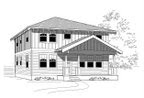
We realized that we should have been giving a real world example from the start.  In light of that, let's do some quick review using our plan The Belmont #3232.  If you recall the equations:

  1. Afloor x Ufloor x ΔTfloor = Btu/hr floor
  2. Awall x Uwall x ΔTwall = Btu/hr wall
  3. Aceil x Uceil x ΔTceil = Btu/hr ceil
  4. Awindows x Uwindows x ΔTwindows = Btu/hr windows
  5. Adoor x Udoor x ΔTdoor = Btu/hr door
This translates to:
  1. Floors: (32x32) x (1/38) x 25°F = 673.68 (1024sf insulated floor, R-38 in joists)
  2. Walls: (32x18x4 - 339.33) x (1/21*.8) x 45°F = 5262.51 (four walls minus windows, 32'L x 18'H, R-21 with framing factor)
  3. Ceiling: (32x32) x (1/49*.8) x 25°F = 522.45 (1024sf ceiling, R-49 with framing factor due to edge pinch)
  4. Windows: 339.33 x 0.30 x 45°F = 4580.96
  5. Doors: 40 x 0.20 x 45°F = 360
We've taken a few liberties but not much.  The end result won't be too drastic.  As you can see, walls will have the highest heat load followed closely by windows.  This is because the wall area is large; for windows the R-value is poor.  Envelope load comes to a grand total of 11399.6 btu/hr.

For air infiltration, recall the formula ΔT x ACHnat x Volume x HC = BTU/hr.  Our ΔT=45°F, volume is 18432 (32x32x18), HC = 0.022, and we'll assume ACHnat to be based off of a blower door test of 5.0ACH, ergo .25.

  • 45°F x .25 x 18432 x 0.022 = 4561.92
Again, not small.  Add up all the bold numbers and this gives a base load of 15961.52.  See, now you're a back of envelope engineer!

Now for the good news!  You will have several internal loads that will help to heat your house, that is, they will make this number smaller.  The biggest source is the occupants.  General convention assumes that there will be 2 people in the master bedroom and one person for each of the other bedrooms.  The Belmont is a 4 bedroom home but practically we could assume four occupants living upstairs.  Occupants put out anywhere from 200 to 300 btu/hr of heat load.  We are preferential towards 275 btu/hr.  For four people, this is a reduction of 1100 btu/hr.  You can also figure in incandescent lights, the kitchen oven, hair dryers and other such pieces.  These don't make a huge difference unless your heat load is so low that you are in PassivHaus range.

Our final result for heating this home in this scenario is 14861.52 btu/hr.  Now what?  Now we need a heat source.  Our first choice might be the typical forced air gas furnace.  A quick look at manufacturer catalogs will reveal that 40,000 btu/hr is the smallest one available.  Even at a low 90% efficiency this will put out 36,000 btu/hr.  But if you have an attached garage, you can always place the furnace there and lose about 40% of your heat bringing the load down to about 25,700 btu/hr.  Let's not.

Another option might be electric wall heaters.  Each 1kW wall heater = 3412 btu/hr.  This calculates to needing 5 heaters.  Reviewing this plan shows that there are up to 10 rooms that would need heat.  Perhaps several 500W units would be more applicable.  Don't forget to install them on an interior wall.

Another choice is a ductless heat pump.  You are limited to a max of 4 heads per unit.  More heads requires another unit which doubles the price.  Or you could get a splitter for some of the heads and share the heat load between rooms.  To outfit the Belmont 3232 you would need one head for the dining/parlor, one split head for the office/bath, another for the master and bath, one more for the auxiliary bedrooms.  The kitchen, utility room and bathroom would need a 500W electric heat source.

Another option might be radiant heat.  In floor hydronic heat puts out 18-25 btu/sf.  Assuming 20btu, you could cover 743sf of the floor with tubing.  But how do you cover 743sf in a 2000sf house?  If you stick to just the walk areas you could make it happen.  But unless you are doing an onsite DIY approach, this option can be super expensive.

The final choice would be to increase some insulation in the walls, try for better windows (U-0.025 is reasonable) and tighten the home to 2.0 ACH or less.  Resulting calculations reduces to 10519 btu/hr.  Then install an HRV in the utility room to cycle fresh air and attach a small heating unit to it.

Any other ideas?

In the very near future we'll refine our simple spreadsheet calculator and make it available for your use.  The calculator does most of the math for you but we made this guide available so you'd know what's going on in the background.  Happy calculating!

Tuesday, October 18, 2011

Calculating More Heat Load

Last week we looked at how to calculate your heat load based on the envelope of your home.  This week we'll take a look at air infiltration and the effect it can have on your home.  The caveat should be given that the tighter you make your home, the more you should be concerned about vapor barriers, retarders, and other management.  Indoor air quality also becomes a concern.  We won't address these issues in this post.

Air infiltration is not something that can be assumed or calculated.  Just as a nail can't be driven by estimation, it needs a tool.  The most common tool used is a blower door.  This is a device that attaches into your front door frame and accepts a large industrial fan.  After closing all other doors and windows, the fan is turned on (generally pointing out) until it is removing 50 cubic feet per minute (CFM) from your home.  Some places in the world aim for 25 CFM.  For a visual, imagine 4 regulation basketballs.  This is 1 cubic foot.  So turning the blower door on to 50 CFM means that you are throwing 200 basketballs out your front door every minute (or more than 3 every second!)

Why in the world would you do this?  A couple of reasons.  First, this is a great opportunity to walk around your house with a smoke stick and see where air is leaking in.  These are places that need to be plugged.  Get your caulk, foam, whatever and fill it up.

Second, since there is diagnostic equipment hooked to the blower door, a technician can determine how much air will blow through your home on a windy day.  The result is a standardized answer that can be used for comparison.  Generally it is in the range of 0-20 air changes per hour (ACH).  This means that with the blower door running, the volume of air in your home could be changed out 20 times an hour.  Every 3 minutes you're getting new air.  This air is coming from outside, the attic, the crawlspace, and the attached garage.

Most newer homes fall around 6 ACH50.  Older homes will be much higher.  It takes some determination to lower a new home from 6 ACH50.  No one accidentally builds a tight home.  With some simple effort we have seen homes approach 4 ACH50.  A bit more effort and change in building methods results in 2 ACH50 which is very good.  The lowest we've ever seen is 0.22 ACH50.  This was a home built to PassivHaus standards.

So why does this matter for energy calculations?  Warm air can be blown out of your home and replaced with cool winter air through leaks.  We need to calculate for this for the furnace to be able to keep up.  Otherwise your home will get cooler and cooler until it equalizes with the outdoors.  This could occur with a 3000sf leaky home and a 40kBTU furnace.  Bad news.

Less talking, more computing.  This is one single formula that has a lot of lead up.  There are four numbers in the formula.  The first is our friend ΔT.  The second is the result of your blower door test in ACH50.  We need natural ACH so divide by 20.  The third is the volume of your heated area.  The fourth is the convective heat transfer co-efficient (HC).  This number has a general range around 0.018 to 0.022:

ΔT x ACHnat x Volume x HC = BTU/hr

Example:  A 1500sf house has a blower door result of 3.5ACH50.  Assume HC to be 0.022 (Marine Cold).  What is the heat loss through infiltration?

Answer: ΔT from last week is still 45°F.  ACHnat = ACH50/20 which is 3.5/20 = 0.175.  Volume is approximately 1500sf x 9' (ceilings) = 13500cf.  HC is stated.  So the formula is 45 x 0.175 x 13500 x 0.022 = 2339 BTU/hr.  Note that we gave a tightness that is half of typical.  Were it 7 ACH50 this load would double!  Don't think air tightness matters?  It's the biggest factor in heat load.

Add this to your envelope load and come back next week for part three, Interior Loads!