

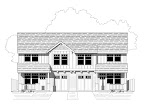
In a flurry of activity and a flood of ink, we finished drafting up not one, not two, not five, but three new houseplans. All are live on our site as I type. "And what are these new, beautiful works of art" you may ask? Without further ado (okay, let's have some drum roll...)
The Richmond B. A longstanding gap has been filled. The Richmond A and C were separated by a void that is now filled. The C had been used to denote the Colonial version while the B had been reserved for the pronounced bay window version. The Richmond B is a reworking of the Richmond, but down to 18' wide and a full 24" deep bay in the dining room. Heck, the dining room IS the bay window. Due to the skinnying factor, minor modifications were made in the kitchen, flex room, and upstairs bedrooms. The upstairs auxiliary bath is no longer directly accessible from the hall but is now a private shared bath for the two bedrooms. The master suite dropped in size as well. Square footage went from 1606 down to 1470. All part of our master plan for minimalization. In fact, 2010 may be the year of all sub-1500sf plans.
The second plan to be released is the Hamblet. No, not a Shakespearean spelling error. The Hamblet is named for a short 5 block street in Northeast Portland, Oregon that is filled with at least a dozen examples of classic homes. We think the Hamblet would fit right in. The only problem we foresee is that the Hamblet is a mere 1374 square feet. Hamblet Street would be prone to double that. With 3 beds, bath and a half, formal dining and living, we think it would still appeal to the aesthetic.
Finally, in an odd turn of events, the Carver B entered the scene. First off, please be aware that if you have a building code in your jurisdiction, the Carver B version may not be for you. We attempted to take all the glory of the Carver and Carver A and make it into a 2 bedroom house - a 300sf 2 bedroom house. To accomplish this we had to ignore the 70sf bedroom rule. The "master" (sarcastic air quotes) bedroom is a whopping 63sf. Yes, you can shoehorn a queen bed in there. Maybe a highboy with 1' deep drawers underneath. The second "bedroom" is a 36sf (including closet) bunk room. There is enough space to walk in, turn around, get undressed, and climb into bed. On top of all that (quite literally) is a 70sf loft that can sleep another two folks adequately. We imagine the Carver B to be a bunkhouse where outdoor activities are more likely.
For all these plans and more, visit our website, drop us an email, or stalk us as we're out and about.
Tuesday, May 4, 2010

Thursday, April 22, 2010
Happy Earth Day
We here at Istockhouseplans believe that every day is Earth Day. That's why we design energy efficiency into all of our plans. And to make up for our length of silence, we'll be releasing several new plans with our next update. Our average square footage has been slowly reducing since our inception. Smaller square footage means less material use which means less of an impact on the earth. All of the plans we'll be releasing are under 1500sf and one of them is only 300sf.
What are YOU doing for Earth Day?
What are YOU doing for Earth Day?
Tuesday, March 30, 2010
Advanced Placement
Energy Trust of Oregon in their never ending quest for energy efficiency in that great state recently introduced their new incentive path for homes. Called Advanced Performance, this path breaks the bar in many ways. Most of us are used to designing and building 2x6 walls. This is going to be a bit of a challenge now. And we're not going to get to do post and beam floors anymore. Here are the specs:
This isn't your Father's energy efficiency path. This is some serious action going on. We at Istockhouseplans are rather excited about this path and would love to help your home achieve it. If you'd like to build any of our plans to this standard, we would be happy to modify it for free. That's right. As a program ally of Energy Trust of Oregon, we'd be so excited to see a home like this get built that we'll do what we can to make it happen. Contact us if you'd like to learn more.
- Framed floors: R-38 joisted (P&B results in leaky floors and/or saggy insulation)
- Slab floors: R-15 full slab with perimeter break
- Walls: U-0.025. This means R-40 assembly, not just R-40 insulation. Either thicker walls or better insulation is required
- Windows: 15% of floor area, U-0.22 weighted average
- Doors: R-5
- Ceiling: U-0.016. Like the walls, this means R-60 assembly, not insulation
- Heating: 8.5 HSPF/13 SEER or better ductless inverter driven heat pump
- Ventilation: HRV/ERV with 70% sensible recovery efficiency
- Tightness: 2.5 ACH50 or better
- Lighting: 90% CFL
- Incentive: $4,000 plus state and federal tax credits
This isn't your Father's energy efficiency path. This is some serious action going on. We at Istockhouseplans are rather excited about this path and would love to help your home achieve it. If you'd like to build any of our plans to this standard, we would be happy to modify it for free. That's right. As a program ally of Energy Trust of Oregon, we'd be so excited to see a home like this get built that we'll do what we can to make it happen. Contact us if you'd like to learn more.
Tuesday, March 16, 2010
Windows 2.0
Ever noticed a new house that tries to look old? Some look terribly fake. Some do a great job. But none of them quite grab the look. Driving around town, it's not hard to spot the infill lots that have brand new period houses on them. We can even tell the difference between a well preserved old house, a well remodeled old home, and a brand new "old" home. Why? What's the difference? The eyes always give it away. In this case, the windows. Windows are a big part of a home and they can have a big effect on the way the home looks.
What is the big difference between old and new home windows? Crappy white vinyl frames? Not necessarily as old windows are often painted white. Grids? Not all old windows had grids and newer windows have some passable grids. We tend to think it's depth. Ever look at an old window? It's part of the framing. Now look at a new window. It's tacked to the outside of the framing like a 'Post No Bills' sign. Am I right? Tell me I'm wrong.
The big difference is in the way window production has changed over the years. When the aluminum flange window arrived on the scene, it made window installation quicker and more forgiving. A non-square opening no longer had to be shimmed to accept an inset window. Now the window could be squared on top of the sheathing and interior trim would cover the other side of the error.
Even though the look has been lost to mass production processes, it's not too hard to bring the look back. The first option is with new inset windows. Sometimes touted as replacement windows, these wood or wood clad panes set inside the framing the way their ancestors used to. There is a price to be paid for these windows though as they are not economically on par with their face flange cousins.
The second option is to use the cheaper face flange windows but spend another 5 minutes on each opening. First, frame your opening to 3" larger than required. Then use a smaller 2x framing member to sub frame your main opening. If you are framing 2x6 walls, line it with 2x4. If you are framing double 2x4 walls, use a piece that is wide enough to cover your interior stud, your gap, and then a little. A 10" double 2x4 wall would require a 2x8 sub frame. Your flange window then mounts to this sub frame and voila! Your windows have the appearance of being integral to the framing instead of slapped on top. A little 5/4 trim around the edges and it's a work of art.
Another benefit to this approach is that your water management just got a lot easier. As long as you have a sloped sill on the outside and a planned drainage path, you're good for the long haul. The water above the window opening gets kicked out by a piece of Z flashing at the head trim.
C'mon, my grandma could do this!
Istockhouseplans is committed to quality design and we hope you'll extend this to your building. Contact us with any questions during your build process and we'll be happy to give you free consultation.
What is the big difference between old and new home windows? Crappy white vinyl frames? Not necessarily as old windows are often painted white. Grids? Not all old windows had grids and newer windows have some passable grids. We tend to think it's depth. Ever look at an old window? It's part of the framing. Now look at a new window. It's tacked to the outside of the framing like a 'Post No Bills' sign. Am I right? Tell me I'm wrong.
The big difference is in the way window production has changed over the years. When the aluminum flange window arrived on the scene, it made window installation quicker and more forgiving. A non-square opening no longer had to be shimmed to accept an inset window. Now the window could be squared on top of the sheathing and interior trim would cover the other side of the error.
Even though the look has been lost to mass production processes, it's not too hard to bring the look back. The first option is with new inset windows. Sometimes touted as replacement windows, these wood or wood clad panes set inside the framing the way their ancestors used to. There is a price to be paid for these windows though as they are not economically on par with their face flange cousins.
The second option is to use the cheaper face flange windows but spend another 5 minutes on each opening. First, frame your opening to 3" larger than required. Then use a smaller 2x framing member to sub frame your main opening. If you are framing 2x6 walls, line it with 2x4. If you are framing double 2x4 walls, use a piece that is wide enough to cover your interior stud, your gap, and then a little. A 10" double 2x4 wall would require a 2x8 sub frame. Your flange window then mounts to this sub frame and voila! Your windows have the appearance of being integral to the framing instead of slapped on top. A little 5/4 trim around the edges and it's a work of art.
Another benefit to this approach is that your water management just got a lot easier. As long as you have a sloped sill on the outside and a planned drainage path, you're good for the long haul. The water above the window opening gets kicked out by a piece of Z flashing at the head trim.
C'mon, my grandma could do this!
Istockhouseplans is committed to quality design and we hope you'll extend this to your building. Contact us with any questions during your build process and we'll be happy to give you free consultation.
Tuesday, March 2, 2010
Free Green at Last, Free Green at Last!
Apologies for being absent for the last month. We were busy working on our entry for the FreeGreen Who's Next? design contest. The contest has 2 profiles, one for yuppies and one for retirees. We chose the yuppies and designed a house that could grow with them. Our design utilizes a 2 bed 1 bath home in 1000sf. There is an approximately 400sf finished attic that is ready for partitions (more bedrooms?). The most exciting feature of the home is the rear deck. It's built on a foundation that can support a future 336sf addition. Simply pull up the deck and build the house!
Competition is hot and heavy with 247 entries. Early voting shows us nowhere near winning but it is early. We're amazed by the number of houses that don't look like houses. If you think Istockhouseplans has got what it takes, show us your support by voting.
Thanks and we'll see you soon!
 |  |
Competition is hot and heavy with 247 entries. Early voting shows us nowhere near winning but it is early. We're amazed by the number of houses that don't look like houses. If you think Istockhouseplans has got what it takes, show us your support by voting.
Thanks and we'll see you soon!
Tuesday, February 2, 2010
From Russia with... lumber?
From the country who brought you the 9-segment LCD display, the motorcycle boat, and a 13-story wooden house, we present to you another fine idea from the former Soviet jewel.
If you can name the model of the car in the video, we'll give you 300 rubles off your next purchase.
If you can name the model of the car in the video, we'll give you 300 rubles off your next purchase.
Tuesday, January 19, 2010
Haitian Dirtbags
For the past week plus we've watched the nation of Haiti fall apart after an earthquake. Reading stories and seeing the images makes us very disappointed that we can't just up and go to help. But what would we do? We have no medical experience. We could help distribute supplies, I suppose. But since our passion is architecture, our thoughts leaned that way. Many people have lost their homes to the 7.0 rumbler. Even the presidential palace is destroyed (as in structurally unsound, not rubble on the ground).
Why did the homes fail? Mostly because of the poor building practices. A good number of homes are concrete with less than adequate mix and not necessarily any rebar. Concrete has the distinction of being inflexible. If you stress it, concrete does not bend, it cracks and breaks. Bad for homes.
So we gave some thought to how we could help the residents of Port-au-Prince. We thought about buying them some rebar, but shipping costs would be a bit high. We thought about designing some prefab homes ala Michael Janzen, but he's got a great product already and lumber is not exactly plentiful on the island.
So then we ran across some blog entries on earthbag homes. What is that, pray tell? Take a bag, fill it with dirt, stack, repeat. Easy. You can check out a Haitian Dirtbag home here that withstood the quake just fine. The owner of this home, Father Theo, cares for orphans in Haiti and runs a blog here. Their other concrete buildings sustained some minor damage. Think this might be a fluke? Check out some earthbag testing here.
"So what?" you might say. "This all looks fine. Are you going to go to Haiti and build earthbag homes?" Not quite. But we believe Father Theo is on to something. Earthbag homes use local materials, can be built in a day, are sturdy, insulative, and cheap. We would like to lobby with Habitat for Humanity to consider rebuilding Port-au-Prince with earthbag homes to avoid any future apocalyptic aftermaths. Once we get that okay, we will begin donating a portion of our plan sales towards buying bags, barbed wire, and any other necessities to rehabilitate Haiti.
You can voice your opinion too by clicking here. Please write and tell them that you think earthbag homes would be the most sustainable housing stock for Haitian revival. May Haiti thrive.
Why did the homes fail? Mostly because of the poor building practices. A good number of homes are concrete with less than adequate mix and not necessarily any rebar. Concrete has the distinction of being inflexible. If you stress it, concrete does not bend, it cracks and breaks. Bad for homes.
So we gave some thought to how we could help the residents of Port-au-Prince. We thought about buying them some rebar, but shipping costs would be a bit high. We thought about designing some prefab homes ala Michael Janzen, but he's got a great product already and lumber is not exactly plentiful on the island.
So then we ran across some blog entries on earthbag homes. What is that, pray tell? Take a bag, fill it with dirt, stack, repeat. Easy. You can check out a Haitian Dirtbag home here that withstood the quake just fine. The owner of this home, Father Theo, cares for orphans in Haiti and runs a blog here. Their other concrete buildings sustained some minor damage. Think this might be a fluke? Check out some earthbag testing here.
"So what?" you might say. "This all looks fine. Are you going to go to Haiti and build earthbag homes?" Not quite. But we believe Father Theo is on to something. Earthbag homes use local materials, can be built in a day, are sturdy, insulative, and cheap. We would like to lobby with Habitat for Humanity to consider rebuilding Port-au-Prince with earthbag homes to avoid any future apocalyptic aftermaths. Once we get that okay, we will begin donating a portion of our plan sales towards buying bags, barbed wire, and any other necessities to rehabilitate Haiti.
You can voice your opinion too by clicking here. Please write and tell them that you think earthbag homes would be the most sustainable housing stock for Haitian revival. May Haiti thrive.
Tuesday, January 5, 2010
Putting our Watts where our Mouth is
For a couple of years now Istockhouseplans has been talking all about energy efficiency and how you should be including it in the homes you build. We've talked about stud spacing, floor joist spacing, truss spacing, thicker walls, advanced framing, and modular design. We've given you plenty of advice (solicited and un-) about what we think the world should be like.
But unlike the doctor who discourages you from smoking and then asks for a light, we can back up our claims. As part of our partnership with Energy Trust of Oregon, we are having our plans energy modeled. We'll start with a base code score and then suggest a few improvements that would be the most suitable regarding energy efficiency and your wallet. If you decide you want to get a lot more creative in your build (R-30 walls?), we can run a preliminary score for you to see how much better your home would be.
We'll spend the next few months updating our portfolio with these numbers and then give you the results. While we don't expect usage numbers in the teens (70's-80's is average), we do expect that you'll be able to give your buyers a more complete picture of their new home. Just another service that Istockhouseplans offers.
But unlike the doctor who discourages you from smoking and then asks for a light, we can back up our claims. As part of our partnership with Energy Trust of Oregon, we are having our plans energy modeled. We'll start with a base code score and then suggest a few improvements that would be the most suitable regarding energy efficiency and your wallet. If you decide you want to get a lot more creative in your build (R-30 walls?), we can run a preliminary score for you to see how much better your home would be.
We'll spend the next few months updating our portfolio with these numbers and then give you the results. While we don't expect usage numbers in the teens (70's-80's is average), we do expect that you'll be able to give your buyers a more complete picture of their new home. Just another service that Istockhouseplans offers.
Tuesday, December 22, 2009
Twenty-Six Point Two
Give up? Maybe you should check out this water heater and see what it means. Fuel usage? Cost? Size? Some strange puzzle based on the bizarre and random thinkings of the post author?
The Marathon hot water heater by Rheem is one of the most efficient tank heaters on the market. We appreciate that it comes as an electric unit. Since electric heat is practically 100% efficient, it makes sense that an electric tank water heater should be up there. The biggest problem with tanks is their standby losses. Leave home for a week and the tank will happily use your utilities to keep the water warm for you the whole time. With efficiencies as high as 94% it is touted that water in the Marathon will stay hot for up to 2 weeks. Awe. Some.
Another interesting player in the game is the Ruud heat pump water heater. Quite a mouthful. This unit combines both technologies into one device and claims an efficiency of 200%. This really shouldn't surprise you if you understand how heat pumps work. Some of the best heat pumps are currently 350% efficient. This water heater works like a refrigerator in reverse. Rather than spit out heat, it grabs it from the air and heats the water with it. We think it would make perfect sense to install one of these next to a fridge and let them work in tandem. Your fridge might appreciate the heat transfer.
We do not own stock in, get money from, or have beers with the representatives of either of these companies. We just think their products are ubercool and we would install them in our own homes. The only thing stopping us is the money that we would get from you buying one of our plans. Of course, istockhouseplans would be happy to specify any water heater you like including a black rubber bladder sitting in the sun. It's your house after all.
The Marathon hot water heater by Rheem is one of the most efficient tank heaters on the market. We appreciate that it comes as an electric unit. Since electric heat is practically 100% efficient, it makes sense that an electric tank water heater should be up there. The biggest problem with tanks is their standby losses. Leave home for a week and the tank will happily use your utilities to keep the water warm for you the whole time. With efficiencies as high as 94% it is touted that water in the Marathon will stay hot for up to 2 weeks. Awe. Some.
Another interesting player in the game is the Ruud heat pump water heater. Quite a mouthful. This unit combines both technologies into one device and claims an efficiency of 200%. This really shouldn't surprise you if you understand how heat pumps work. Some of the best heat pumps are currently 350% efficient. This water heater works like a refrigerator in reverse. Rather than spit out heat, it grabs it from the air and heats the water with it. We think it would make perfect sense to install one of these next to a fridge and let them work in tandem. Your fridge might appreciate the heat transfer.
We do not own stock in, get money from, or have beers with the representatives of either of these companies. We just think their products are ubercool and we would install them in our own homes. The only thing stopping us is the money that we would get from you buying one of our plans. Of course, istockhouseplans would be happy to specify any water heater you like including a black rubber bladder sitting in the sun. It's your house after all.
Tuesday, December 8, 2009
Where Energy Efficiency Counts
Think you know how to save energy? Test yourself. Are the following measures efficient? (Is the payback period or energy savings worth the cost?):
Yearly furnace tune-ups: Y N
Properly sized furnace: Y N
Sealing basement ducts: Y N
Underfloor insulation: Y N
Caulking & weatherstripping: Y N
Window replacement: Y N
Tankless gas water heaters: Y N
Attic cooling: Y N
Did you answer no to any of the questions?
You get 1 point for every 'no' and zero points for every 'yes'. We were a little blown away too. Michael Blasnik with the Department of Energy has found that these measures on average are worthless and merely feel good. You can read his article to get a complete explanation of why these measures don't add up as well as a few more.
We at istockhouseplans were a little disappointed to see real world results on the tankless gas heater. Maybe electric is still okay? We've been promoting these in our homes and not setting aside a specific space for a tank water heater. Most of our homes do have enough space to put a water heater tank, either in a large closet, under stairs, or in the laundry room. Next time we'll review a couple of tank heaters that we've found to be very efficient.
Also check out our istock4kids page where we've put two more puzzles to delight and entertain.
Yearly furnace tune-ups: Y N
Properly sized furnace: Y N
Sealing basement ducts: Y N
Underfloor insulation: Y N
Caulking & weatherstripping: Y N
Window replacement: Y N
Tankless gas water heaters: Y N
Attic cooling: Y N
Did you answer no to any of the questions?
You get 1 point for every 'no' and zero points for every 'yes'. We were a little blown away too. Michael Blasnik with the Department of Energy has found that these measures on average are worthless and merely feel good. You can read his article to get a complete explanation of why these measures don't add up as well as a few more.
We at istockhouseplans were a little disappointed to see real world results on the tankless gas heater. Maybe electric is still okay? We've been promoting these in our homes and not setting aside a specific space for a tank water heater. Most of our homes do have enough space to put a water heater tank, either in a large closet, under stairs, or in the laundry room. Next time we'll review a couple of tank heaters that we've found to be very efficient.
Also check out our istock4kids page where we've put two more puzzles to delight and entertain.
Friday, December 4, 2009
Small Bonus Post
Found this in The Daily Oregonian from Portland, Oregon:
"I think there are two significant movements in the country," Chapin says. "One is that bigger is better; that's been the prevailing notion for the last 50 years. Another movement says small is beautiful.
"I think the first movement is moving toward its sunset, and the second is more on the rise."
Small Houses go Big-time
"I think there are two significant movements in the country," Chapin says. "One is that bigger is better; that's been the prevailing notion for the last 50 years. Another movement says small is beautiful.
"I think the first movement is moving toward its sunset, and the second is more on the rise."
Small Houses go Big-time
Tuesday, November 24, 2009
Small Homes in the News
Istockhouseplans is proud to announce the release of two new plans, the Carver and the Carver A. Both plans cover 18' wide by 22' deep including the porch. Both plans are just under 300sf with a sleeping loft of almost 100sf. These are some intentional entries into the small house plan market and we are proud to showcase them.
We at istockhouseplans aren't the only ones who think small is the new big. We've found some great articles that tout small and some just lambast bombast. Click the links for further reads. Unfortunately, some publishers require a login to access the full article and we just aren't allowed to copy and paste it. Maybe you're already signed up with them and we brought this to your attention.
Fine Homebuilding.
Wall Street Journal. Be sure to check out the interactive graphics.
Los Angeles Times photo story.
San Francisco Chronicle. Some interesting comments.
You can see the rest of our tiny homes as well.
We at istockhouseplans aren't the only ones who think small is the new big. We've found some great articles that tout small and some just lambast bombast. Click the links for further reads. Unfortunately, some publishers require a login to access the full article and we just aren't allowed to copy and paste it. Maybe you're already signed up with them and we brought this to your attention.
Fine Homebuilding.
Wall Street Journal. Be sure to check out the interactive graphics.
Los Angeles Times photo story.
San Francisco Chronicle. Some interesting comments.
You can see the rest of our tiny homes as well.
Subscribe to:
Posts (Atom)


 Posts
Posts

